
When the Magic App Wants to Be Seen
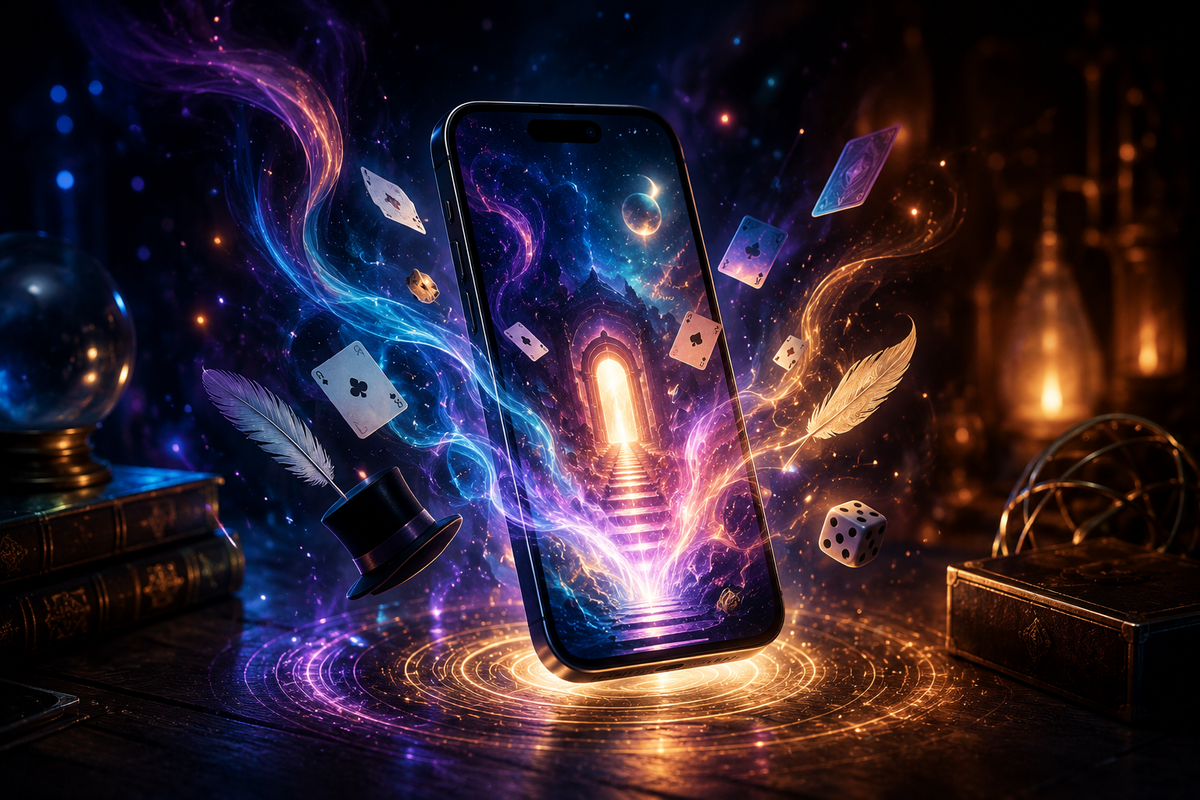
For years, one of the most effective ideas in digital magic has been simple: make the magic app look like something the spectator already knows.
A calculator. A camera. A messaging app. A familiar interface.
When done well, this approach is incredibly powerful. The spectator recognizes the environment, lowers their guard, and the impossible can happen inside something that feels completely ordinary.
But there is another philosophy of magic app design.
One that does almost the exact opposite.
Instead of hiding, the app wants to be seen.
It has its own visual identity. Its own interface. Sometimes its own characters, sounds, animations and fictional world.
And rather than pretending that the smartphone is just an ordinary smartphone, it turns the device itself into part of the magical experience.
The App Becomes Part of the Show
With this kind of magic app, there is no need to convince the spectator that they are looking at a normal utility.
The application can immediately establish its own universe.
Opening it can feel like opening a mysterious object.
The interface may be elegant, strange, playful, cinematic or deliberately theatrical. A card may appear in three dimensions. A fictional machine may come to life. An impossible object may react to the spectator. Sounds, animations and transitions can build anticipation before the effect has even happened.
In traditional magic, the magician might introduce an unusual box, an old book, a strange deck of cards or an intriguing object.
Nobody asks why the box doesn't look like an everyday object.
Its unusual appearance is part of its appeal.
A magic app can work in exactly the same way.
The smartphone simply becomes the container.
Design Is No Longer Camouflage
When an app imitates a familiar application, design has an important job: be convincing.
Every detail matters because anything unusual can create suspicion. Typography, icons, spacing, animations and interactions need to feel natural.
But when a magic app embraces its own identity, design has a very different role.
It can become expressive.
Colors can establish a mood. Animations can create tension. Sound can signal that something is about to happen. 3D objects can invite exploration. Typography can reinforce a fictional universe.
The interface is no longer trying to disappear.
It is helping tell the story.
This gives developers and magicians enormous creative freedom.
A magic trick no longer has to be designed only around the secret method. The entire experience surrounding the secret can be designed as well.
Magic Apps Can Tell Stories
This is perhaps the biggest opportunity.
A magic app can have a beginning, a progression and a conclusion.
Instead of simply asking someone to think of a card and revealing it a few seconds later, the app can take the spectator somewhere.
Perhaps they are boarding a mysterious flight.
Perhaps they are exploring an old machine.
Perhaps they are communicating with a fictional character.
Perhaps they are solving something.
Perhaps the phone appears to understand decisions that should be impossible for it to know.
The effect remains important, of course.
But now there is something surrounding it.
A world.
And that world can give meaning to the magic.
A revelation is often stronger when the spectator understands why it is happening inside the story they have just experienced.
The Spectator Becomes a Participant
This approach also changes the spectator's role.
They don't necessarily have to stand beside the magician and watch an interface being manipulated.
They can explore.
Tap.
Swipe.
Rotate an object.
Make decisions.
Follow instructions.
Discover clues.
Trigger events.
The smartphone is particularly suited to this kind of magic because spectators already understand how to interact with it.
There is very little learning required.
That creates an interesting opportunity for magicians: instead of using technology only to produce a secret, technology can be used to build participation around the secret.
The spectator is no longer simply witnessing a digital trick.
They are moving through a magical experience.
But This Approach Takes More Risks
There is a price for all this creative freedom.
The moment a magician openly presents a dedicated magic application, the spectator knows that the software is special.
That changes the psychology of the effect.
With an ordinary-looking interface, part of the strength can come from the apparent impossibility that anything unusual could be happening.
With an openly magical app, that protection disappears.
The spectator may think:
"The app is obviously doing something."
And that means the experience has to work harder.
The method needs to be clever.
The interaction needs to feel justified.
The presentation needs to be strong.
And most importantly, the final magical moment needs to go beyond what the spectator believes a smartphone should reasonably be able to do.
In other words, these apps take a bigger creative risk.
But that risk also creates a much larger canvas.
The Secret Is Only One Layer
This leads to an important distinction.
A magic app can be technically brilliant and still provide a poor magical experience.
The secret method is only one layer.
There is also pacing.
Interaction.
Sound.
Visual design.
Storytelling.
Surprise.
Emotion.
And the role given to the spectator.
When all of these elements support each other, the smartphone stops feeling like a piece of technology running a trick.
It becomes something closer to a digital magic prop.
Except unlike a physical prop, it can transform itself continuously.
A screen can become a table.
A portal.
A deck of cards.
A machine.
A map.
A fictional world.
Anything the creator can imagine.
Two Different Philosophies, Not Two Opposing Camps
This doesn't mean that openly magical apps are better than apps designed to look familiar.
They solve different problems.
An app that convincingly resembles something the spectator already knows can create extraordinary magic precisely because it feels ordinary.
An app with its own identity can create extraordinary magic for the opposite reason: because it allows the spectator to enter something extraordinary.
One hides the technology behind familiarity.
The other embraces technology and asks:
What kind of magical experience can we build with it?
Both approaches belong in modern digital magic.
And some of the most interesting ideas may even exist somewhere between the two.
The Smartphone as a New Kind of Magic Prop
Magic has always evolved alongside the objects people use.
Coins, watches, playing cards, photographs, telephones and televisions have all found their way into performances.
The smartphone may simply be the next great magic prop.
But it has one unusual advantage over almost everything that came before it:
it can become anything.
That gives today's magicians and developers an extraordinary opportunity.
Not simply to recreate traditional tricks on a screen.
Not simply to hide clever methods inside familiar interfaces.
But to invent experiences that could never have existed without the smartphone.
When a magic app fully embraces its identity, the question is no longer:
"How can we make this look like a normal app?"
It becomes a much more exciting question:
"What kind of magic can this app make someone experience?"