
When Magic Apps Look Like Apple Apps: The Power of Familiarity
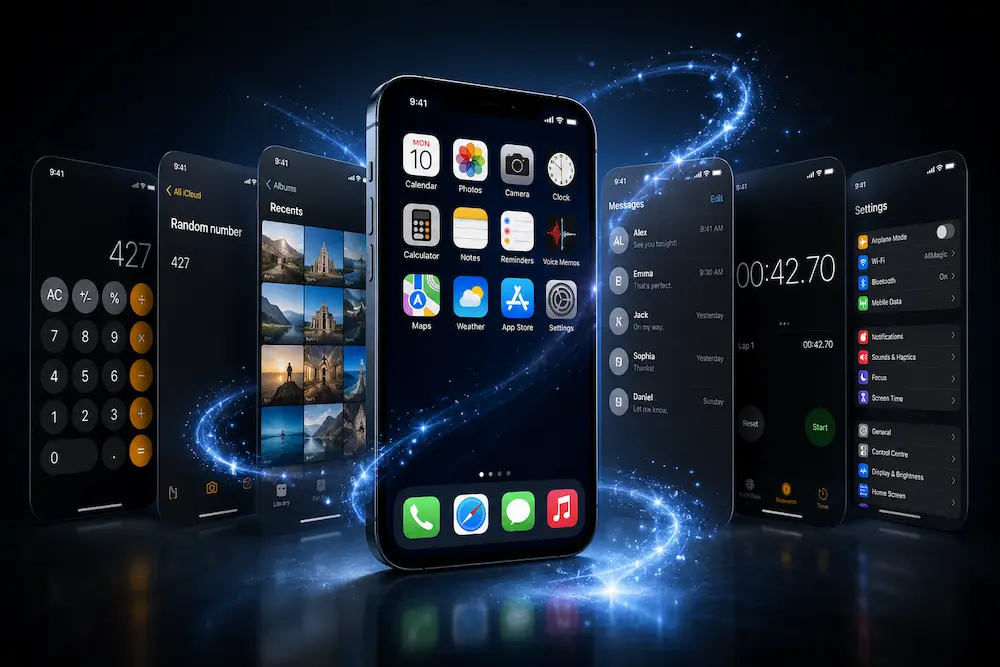
Some of the most fascinating magic apps hide in plain sight.
Instead of presenting themselves as magical tools, they reproduce something spectators already know extremely well: a familiar iPhone interface.
Calculator. Notes. Photos. Messages. Clock. Settings.
At first glance, there is nothing unusual to see.
And that is precisely the point.
When a magic app convincingly reproduces a familiar Apple application or system interface, it can take advantage of something incredibly powerful in magic: the spectator's existing habits and expectations.
The audience does not have to discover the interface. They have already seen it, used it and developed expectations about how it should behave.
The magic begins inside something they believe they already understand.
Familiarity Creates Immediate Confidence
Think about how many times an iPhone user has opened Calculator, Photos, Notes or Messages.
Potentially thousands.
Over time, these interfaces become almost invisible. People no longer consciously analyze the position of every button or the shape of every icon. They simply recognize the application and know how to use it.
That recognition creates confidence.
When spectators see what appears to be Apple's Calculator, they don't need an introduction to understand what is happening on the screen.
They already know what a calculator does.
The same is true for Photos, Notes, Clock and many other familiar interfaces.
This gives the magician an interesting psychological advantage: the spectator arrives with their own knowledge of the object before the effect has even started.
The magician does not need to create that familiarity.
Apple has already created it.
Years of Habit Become Part of the Effect
What makes these interfaces particularly interesting for magic is not simply their appearance.
It is the history spectators have with them.
Someone who has owned an iPhone for years has developed countless small habits.
They know approximately where buttons should be.
They know how screens transition.
They know how the keyboard appears.
They know how numbers behave inside Calculator.
They know how photographs move inside Photos.
They may not consciously remember every detail, but they have developed a strong sense of what feels normal.
A magic app can use this existing experience as part of the illusion.
The spectator is not discovering a new digital environment.
They are returning to one they already know.
Recognition Happens Almost Instantly
Human beings are remarkably fast at recognizing familiar visual environments.
A few elements can be enough.
The background.
The typography.
The position of a button.
A familiar icon.
A navigation bar.
Within a fraction of a second, the spectator's brain may have already classified what they are seeing:
"That's the Calculator."
Or:
"That's Photos."
Once that classification happens, something important has occurred.
The spectator has created an expectation about what the screen can and cannot do.
And expectations are extremely valuable in magic.
The Power of Predictable Behavior
A familiar application comes with rules.
A calculator calculates.
A clock displays time.
A photo gallery contains photographs.
A notes application contains text.
These functions are so ordinary that we barely think about them anymore.
This gives the magician a very clear starting point.
Everything appears to behave exactly as expected.
A number is entered.
A photograph is opened.
A note is displayed.
A timer is started.
Nothing feels magical yet.
And then something impossible happens.
That transition from the completely familiar to the completely unexpected can create a particularly strong magical moment.
The spectator knows what the application is supposed to do.
That is exactly why seeing it apparently do something impossible can be so surprising.
Trust Is Built Before the Trick Begins
One of the fascinating aspects of this approach is that part of the credibility already exists before the performance.
Apple has spent decades creating consistent interfaces used by millions of people around the world.
Spectators know those interfaces.
They associate them with their own devices and their own everyday experiences.
A magic app that successfully reproduces one of those environments can inherit some of that familiarity.
This doesn't mean the spectator is consciously thinking:
"I trust this because it looks like an Apple application."
The process is usually much more subtle.
They simply see something normal.
And in magic, normality can be incredibly useful.
The Surprise Comes From Breaking an Established Rule
Magic often becomes stronger when the audience clearly understands the conditions before the impossible moment occurs.
A familiar digital interface provides those conditions naturally.
If everyone knows how a calculator works, the magician does not need to establish its basic rules.
If everyone understands what a photo gallery is, there is no need to explain what photographs normally do.
The audience already knows.
The magician can therefore play directly with those expectations.
The sequence becomes beautifully simple:
recognition → expectation → normal behavior → impossible behavior
The stronger the expectation, the more striking its violation can become.
Accuracy Is Essential
There is, however, an important challenge.
When reproducing something people see every day, small mistakes matter.
A spectator probably cannot tell you the exact corner radius Apple uses for a particular button.
They may not know the name of the system font.
They probably cannot describe the precise animation used when navigating between two screens.
But they may still notice when something feels wrong.
The font weight is slightly different.
The spacing feels unusual.
A button is too large.
An icon is outdated.
The keyboard does not appear naturally.
A transition happens differently.
The colors are slightly off.
The spectator might not consciously identify the problem.
They may simply experience a tiny moment of doubt:
"Something looks different."
For this type of magic app, that moment matters.
It Must Feel Right, Not Just Look Right
A convincing reproduction goes beyond visual similarity.
The interaction itself matters.
Buttons should react naturally.
Scrolling should feel right.
Animations should follow the expected rhythm.
Gestures should behave normally.
The keyboard should appear where expected.
Haptic feedback may even contribute to the illusion.
This is an interesting challenge for developers because they are not simply recreating a screen.
They are recreating behavior.
A screenshot can reproduce appearance.
A convincing magic app has to reproduce experience.
And spectators have years of experience against which to compare it.
The Small Details Become Invisible Proof
Ironically, many of the most important details are things spectators will never consciously notice.
That is exactly why they matter.
Correct spacing will probably never receive attention.
Neither will the right animation curve, typography, icon size or transition.
But all these elements contribute to the same conclusion:
Everything feels normal.
In this context, good design is almost invisible.
Every accurate detail quietly reinforces the spectator's existing assumption about what they are seeing.
No single element proves anything.
Together, they create credibility.
iOS Updates Create a Unique Challenge
There is another difficulty with this category of magic application: the target keeps changing.
Apple regularly evolves iOS.
Typography changes.
Icons change.
Navigation patterns change.
Animations change.
Applications are redesigned.
System components evolve.
Even relatively small visual updates can matter when the objective is to reproduce an interface spectators see every day.
A magic app that looked perfectly authentic several years ago may eventually begin to feel dated.
That makes maintenance particularly important.
Developers need to observe new versions of iOS carefully and decide whether their interfaces need to evolve with them.
For these apps, updating is not simply about compatibility.
Sometimes it is part of preserving the illusion.
Don't Draw Attention to the Disguise
There is also an important performance consideration.
If an interface is immediately recognizable, it may not need to be justified.
Repeatedly insisting that something is "the normal Calculator" or "the real Photos app" can sometimes encourage spectators to examine something they would otherwise have accepted instantly.
The familiarity of the interface can often do the work by itself.
The spectator sees it.
Recognizes it.
Accepts it.
And the performance continues.
When the design is convincing, the magician may not need to sell the illusion.
The interface sells itself.
Familiarity Is a Magical Tool
What makes these magic apps so interesting is that their secret weapon is not necessarily hidden inside the code.
Part of it exists inside the spectator's memory.
Years of using smartphones have created an enormous vocabulary of familiar digital objects.
We recognize calculators, keyboards, notifications, photo galleries, messages, clocks and system screens almost instantly.
A clever magic app can use that vocabulary just as a magician uses familiar physical objects.
The audience knows what these things are.
They know how they should behave.
And they know what should be possible.
Until suddenly, it isn't.
When the Interface Disappears
Perhaps the greatest achievement for this type of magic app is when nobody notices the design at all.
The spectator should not be impressed by how accurately the interface has been reproduced.
Ideally, they should never realize that there was anything to reproduce.
They simply recognize something familiar and continue watching.
The technology becomes invisible.
The interface becomes ordinary.
And all that remains is the impossible moment.
That is the fascinating paradox behind magic apps inspired by native Apple interfaces:
the more ordinary they appear, the more extraordinary the magic can feel.