
What Happens When a Magic App Dies?
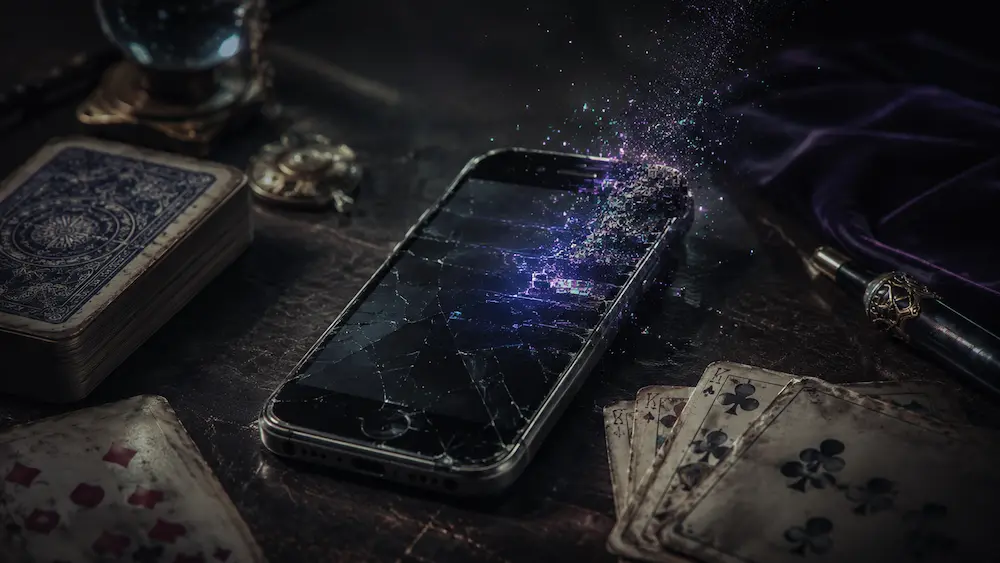
Magic has always had a strange relationship with time.
A deck of cards can survive for decades. A mechanical gimmick can be repaired. A book printed fifty years ago can still teach the same technique today.
A magic app is different.
It lives inside an ecosystem that constantly changes: operating systems evolve, phones disappear, APIs are deprecated, servers shut down, accounts expire, and developers move on.
So what happens when a magic app dies?
For magicians who increasingly rely on smartphones as genuine performance tools, this is becoming an important question.
A Trick You Do Not Completely Own
When you buy a physical magic prop, the relationship is relatively simple.
You own the object.
As long as it still works physically, you can continue performing the effect.
With a magic app, ownership is much more complicated.
The app may be installed on your phone, but its ability to function can depend on many external elements:
- the operating system
- the App Store or Google Play Store
- the developer maintaining compatibility
- internet connectivity
- remote servers
- external APIs
- cloud services
- authentication systems
- subscriptions
- AI services
Any one of these components can disappear.
And when that happens, an effect that worked perfectly yesterday may suddenly become impossible to perform.
That makes digital magic fundamentally different from most traditional magic props.
The Operating System Problem
Every year, Apple and Google introduce changes to their operating systems.
Most of the time, users barely notice what happens behind the scenes.
Developers do.
Permissions change. Frameworks evolve. Security rules become stricter. Old technologies are removed. Behaviors that were once allowed may suddenly work differently.
For a regularly maintained application, this is usually manageable.
The developer updates the app and adapts it.
But what happens when the developer is no longer maintaining the project?
A perfectly functional magic app can slowly become incompatible.
At first, perhaps a button behaves strangely.
Then a permission stops working.
Eventually, the application may no longer launch at all.
The magic effect itself has not become obsolete.
The environment around it has.
The Disappearing Developer
Magic apps are often created by very small teams.
Sometimes by a single magician-developer.
That is part of what makes the magic app world so creative. One person with a clever idea can create an effect and distribute it worldwide.
But it also creates fragility.
What happens if that developer stops working on the app?
Maybe they lose interest.
Maybe maintaining the software becomes too expensive.
Maybe they start another career.
Maybe the number of users becomes too small to justify continued development.
The application can remain available for some time, but without maintenance, every new operating system update becomes a potential threat.
Eventually the app may disappear from the store entirely.
And once it is gone, reinstalling it on a new device may become difficult or impossible.
When the Server Disappears
Some magic apps appear to live entirely on your phone but actually rely on remote infrastructure.
The app may need to contact a server to retrieve information, synchronize data, process a request, verify an account, or perform part of the effect.
While the server exists, everything feels seamless.
When it disappears, the app can become useless instantly.
This creates an important distinction between two types of magic apps:
Apps that merely use the internet
and
apps that require the internet to exist.
The difference may not matter much during the first year of ownership.
Five years later, it can matter enormously.
The Invisible Cost of External Services
Modern apps increasingly rely on services that developers do not control.
Maps, messaging platforms, databases, cloud hosting, artificial intelligence, speech recognition and many other technologies are frequently provided through external APIs.
These services can be extremely powerful.
They also create dependency.
Pricing can change.
Usage limits can change.
Terms of service can change.
An API can be discontinued.
A feature that was once free may become expensive to operate.
This becomes particularly relevant with AI-powered magic applications.
Every request sent to a large language model can have a cost.
One performance may cost almost nothing.
Thousands of users performing the effect repeatedly can create a significant monthly bill.
The magician may have purchased the app once, but the developer may continue paying for every performance indefinitely.
That economic model is not always sustainable.
Hardware Can Kill an Effect Too
Software is only part of the problem.
Magic apps sometimes depend on specific hardware behavior.
A particular sensor.
A certain screen design.
A camera capability.
A vibration motor.
A microphone.
A proximity sensor.
A specific interaction gesture.
Smartphones evolve rapidly.
Features appear, disappear or change.
An effect designed around one generation of hardware may behave differently several generations later.
This does not necessarily mean the app was poorly designed.
It simply means the magician is performing with a device that was never meant to remain unchanged.
The Professional Magician's Problem
For a casual user, losing an old app can be disappointing.
For a professional magician, it can be much more serious.
Imagine building a routine around an application.
You rehearse it.
You develop the presentation.
You learn the timing.
You perform it hundreds of times.
The effect becomes part of your professional repertoire.
Then one day, a system update breaks the app.
Suddenly you are not simply losing software.
You are losing part of your act.
This is why reliability matters differently in magic than in ordinary consumer applications.
A weather app failing for an evening is annoying.
A magic app failing in front of an audience can destroy the effect completely.
Should Magicians Keep Old Phones?
Some performers already have a simple solution.
They keep an older phone dedicated to specific effects.
No automatic system updates.
No unnecessary apps.
No changes.
Essentially, the smartphone becomes a digital magic prop.
There is something strangely logical about this.
Once a phone becomes part of a professional routine, stability may be more valuable than having the latest operating system.
The device stops being simply a phone.
It becomes equipment.
Of course, this approach introduces other problems.
Batteries age.
Hardware eventually fails.
Replacement devices become harder to find.
Even preserving old technology requires planning.
Offline Apps Have a Hidden Advantage
An app that works entirely offline has one enormous long-term advantage.
Independence.
No server needs to remain online.
No external API needs to survive.
No account needs to be authenticated.
No ongoing infrastructure bill exists.
If the operating system still supports the app, the effect can theoretically continue working indefinitely.
That does not automatically make offline apps better.
Connected applications can produce effects that would be impossible otherwise.
But independence is a genuine feature, even if it is rarely mentioned on the product page.
For professional users, it may be one of the most important features of all.
Should Longevity Be Part of a Review?
When magic apps are reviewed, we usually talk about the obvious things.
How strong is the effect?
How deceptive is it?
Is the interface convincing?
Is it easy to perform?
Is the method practical?
But perhaps another question should become standard:
How likely is this effect to keep working?
A reviewer could consider several factors.
Does the app require an internet connection?
Does it depend on an external account?
Does it use remote servers?
Does it rely on third-party APIs?
Is the developer still actively maintaining it?
Does the app receive regular updates?
Can the core effect function offline?
None of these questions determine whether an app is good or bad.
They simply reveal something else:
its level of technological dependency.
Developers Face a Difficult Responsibility
It would be unfair to place all responsibility on developers.
Maintaining software forever is impossible.
Operating systems change.
Development tools change.
Hosting costs money.
External services become expensive.
A magic app sold to a relatively small audience may generate very little revenue years after launch while still requiring maintenance.
A developer may genuinely want to keep an app alive but discover that doing so no longer makes economic sense.
This is one of the difficult realities of digital products.
Software has a maintenance cost even after the original development work is finished.
Perhaps We Need a Different Way to Think About Magic Apps
Maybe the mistake is expecting digital magic to behave like physical magic.
A brass gimmick can survive for generations.
Software belongs to a living technological environment.
Instead of asking whether a magic app will work forever, perhaps we should ask something more realistic:
How dependent is this effect on the world around it?
Some apps are almost self-contained.
Others depend on an entire chain of services.
Neither approach is automatically wrong.
But magicians should know the difference.
Especially when choosing effects they intend to perform professionally.
Digital Magic Is Powerful — But Temporary by Nature
Smartphones have created extraordinary possibilities for magic.
They can communicate invisibly, process information, recognize speech, access enormous databases and simulate interfaces spectators already trust.
Those possibilities continue to grow.
But digital magic comes with a trade-off.
The tool itself is constantly changing.
Every magic app exists inside a technological ecosystem that the magician — and often even the developer — cannot completely control.
That does not make magic apps unreliable by definition.
It simply means that longevity deserves to be part of the conversation.
Because when we buy a magic app, we are not only buying an effect.
We are also trusting an ecosystem to keep that effect alive.
And eventually, every magician who uses technology may have to face the same question:
What happens when the magic app dies?