
The Spectator's Smartphone Is No Longer Just a Prop
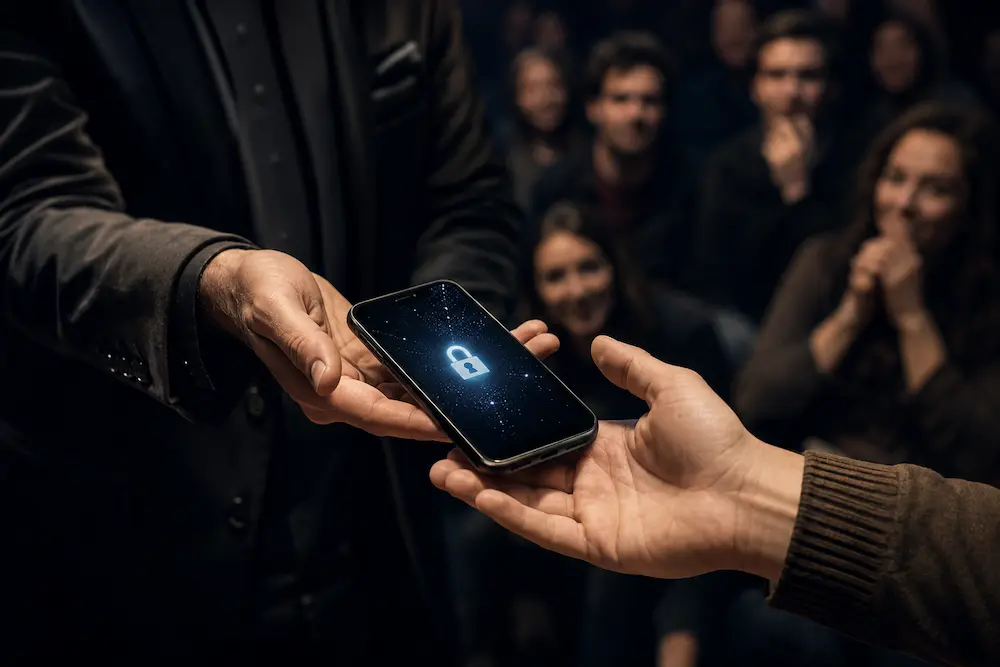
Why Borrowing Someone's Phone Has Become One of the Biggest Challenges in Modern Digital Magic
For years, borrowing a spectator's phone has been considered one of the strongest convincers in digital magic.
Using their device instead of yours immediately removes one obvious explanation. There is "nothing to hide." No prepared phone. No suspicious app already installed.
This philosophy has inspired countless routines involving Safari bookmarks, web applications, QR codes, NFC tags, App Clips, shortcuts, or temporary websites.
But something has changed.
In 2026, a smartphone is no longer just a phone.
It is someone's wallet.
Their identity.
Their private life.
And as magicians, we should ask ourselves an important question:
Should we still be asking strangers to hand us one of the most personal objects they own?
Our Relationship With Smartphones Has Changed
Ten years ago, lending someone your phone wasn't a big deal.
Today, that same device contains:
- banking applications;
- digital IDs;
- passwords;
- private conversations;
- family photos;
- health information;
- authentication codes;
- business emails;
- payment methods.
Many people unlock their phones hundreds of times every day without thinking.
But handing that unlocked device to someone they have just met?
That is becoming increasingly uncomfortable.
Not because they suspect the magician...
...but because society has become much more aware of digital privacy.
"Can I Borrow Your Phone?"
For a magician, this sounds perfectly innocent.
For a spectator, however, several thoughts may instantly appear:
- What is he going to do?
- Is he installing something?
- Will he access my photos?
- Can he read my messages?
- Is this website safe?
- What happens if something changes on my phone?
Even if none of these fears are justified, the audience may still feel uneasy.
Magic should create wonder—not anxiety.
The Rise of Safari-Based Magic
Many modern routines avoid asking spectators to install a full application.
Instead, performers simply ask them to:
- open Safari;
- type a web address;
- scan a QR code;
- add a shortcut to the Home Screen;
- launch a Progressive Web App;
- or use an App Clip on iPhone.
Technically, these solutions are elegant.
They reduce friction and often require only a few seconds.
But from the spectator's point of view, they may still feel unusual.
People are becoming increasingly cautious about opening unknown websites or interacting with unfamiliar digital content.
Modern browsers and operating systems ask for permission before granting access to sensitive features such as the camera, microphone, location, local network, or notifications. These protections exist precisely because users expect to remain in control of their personal devices.
App Clips Feel Safer... But Questions Remain
Apple introduced App Clips to make lightweight experiences possible without requiring users to install a full application.
They are fast.
They disappear automatically after a period of inactivity.
They request only a limited set of permissions and cannot track users across other companies' apps and websites like full apps can.
For magic creators, App Clips are incredibly attractive.
However, spectators often don't understand the difference between:
- an App Clip;
- a native application;
- a website;
- or a shortcut.
To many people, it simply feels like "installing something."
Perception matters just as much as technology.
Trust Is Part of the Performance
A magician spends years building trust.
That trust can disappear in seconds if a spectator becomes worried about their phone.
Imagine this situation:
The spectator unlocks their iPhone.
The magician begins navigating through Safari.
Several system dialogs appear.
Permissions are requested.
A loading screen appears.
The audience is no longer thinking about the magic.
They are wondering what is happening to the phone.
The secret method suddenly becomes less important than the perceived digital risk.
The Risk of Physical Damage
There is another concern that is often overlooked: physical damage to the spectator's phone.
Modern smartphones are incredibly expensive. Many flagship devices now cost well over $1,000, and for many people they are among the most valuable objects they carry every day.
When a magician asks to hold a spectator's phone, they are also accepting a certain level of responsibility.
Accidents happen.
A phone can slip from your hand.
It can fall onto a hard floor.
It can be knocked over by another spectator.
A drink might be spilled during the performance.
Even something as simple as placing the phone on a table can end badly if it vibrates, slides, or is accidentally pushed.
Regardless of who is legally responsible, the performance has instantly stopped being about magic.
Instead of remembering an impossible moment, the spectator remembers a cracked screen, a damaged camera, or an expensive repair.
Professional performers understand that risk management is part of every show. We avoid exposing borrowed watches to unnecessary danger, we protect borrowed rings, and we treat personal belongings with extreme care.
Smartphones deserve the same level of respect.
Whenever possible, the safest approach is to let the spectator keep their phone in their own hands throughout the routine. Not only does this reduce the risk of accidental damage, but it also reinforces trust and allows the audience to focus entirely on the magic rather than worrying about the safety of their device.
What Happens If Something Goes Wrong?
Even if your routine is perfectly safe, unexpected situations can occur.
For example:
- the phone freezes;
- the browser crashes;
- the battery dies;
- the spectator accidentally closes the page;
- Wi-Fi becomes unavailable;
- an unexpected system notification appears.
Or even worse...
The spectator later discovers an unrelated issue on their phone.
A missing photo.
A changed setting.
A payment problem.
A software update.
Even if your routine had absolutely nothing to do with it, people naturally connect recent events.
"The magician used my phone..."
That association alone can create uncomfortable conversations.
The Legal and Ethical Side
Most professional magicians would never intentionally access a spectator's personal information.
However, touching another person's unlocked smartphone inevitably creates responsibility.
Even accidentally opening a notification, exposing a private message, or revealing a contact name could create embarrassment.
In some countries, privacy regulations have become increasingly strict, and users are far more conscious of how their personal devices and data are handled than they were only a few years ago.
Being respectful is no longer simply good manners.
It is part of professional performance.
The Audience Doesn't Understand Permissions
Developers often know exactly what an application can and cannot access.
Spectators usually don't.
When a permission dialog appears asking for:
- camera access;
- microphone access;
- location;
- notifications;
- local network;
- or clipboard access,
many people immediately become suspicious.
Apple intentionally requires explicit consent before apps or App Clips can access sensitive information, giving users visibility and control over what each experience can do.
The problem isn't necessarily the permission itself.
The problem is uncertainty.
There Are Better Alternatives
Fortunately, digital magic has evolved.
Many incredible routines today allow the spectator to remain fully in control.
For example:
- the spectator performs every interaction themselves;
- the magician never touches the phone;
- a QR code is scanned independently;
- the phone stays in the spectator's hands throughout the routine;
- or the effect happens on the magician's own device instead.
These approaches often feel even stronger.
The audience never has to wonder whether something happened while the magician was holding the phone.
Designing Magic for Today's World
As creators, we sometimes become fascinated by technology.
But spectators care less about the technology...
...and much more about the experience.
A routine that requires five permissions, three browser interactions, and several setup steps may be technically brilliant.
Yet a simpler routine that respects the spectator's comfort may create a much stronger emotional impact.
The best digital magic is often invisible.
Not because the technology is hidden...
But because the audience never feels uncomfortable using it.
The Future of Borrowed Phones
Borrowed-phone magic is certainly not disappearing.
It will continue to produce astonishing moments.
But the expectations of audiences are changing.
Today's spectators value privacy.
They understand cybersecurity.
They receive scam warnings almost daily.
They are trained not to trust unfamiliar links.
This means modern digital magicians must adapt.
The strongest routines of tomorrow may not be those that do the most impressive technical tricks.
They may be the ones that require the least intrusion into the spectator's personal device.
Final Thoughts
Digital magic has never been more powerful.
App Clips, web applications, NFC, QR codes, and connected devices allow creators to imagine effects that would have seemed impossible just a few years ago.
But with great technology comes greater responsibility.
Every time we ask to borrow a spectator's smartphone, we are not simply borrowing a prop.
We are borrowing something deeply personal.
Respecting that trust is just as important as creating an impossible effect.
Because in modern magic, protecting the spectator's confidence may be the greatest illusion of all.