
The Different Business Models for Selling Magic Apps
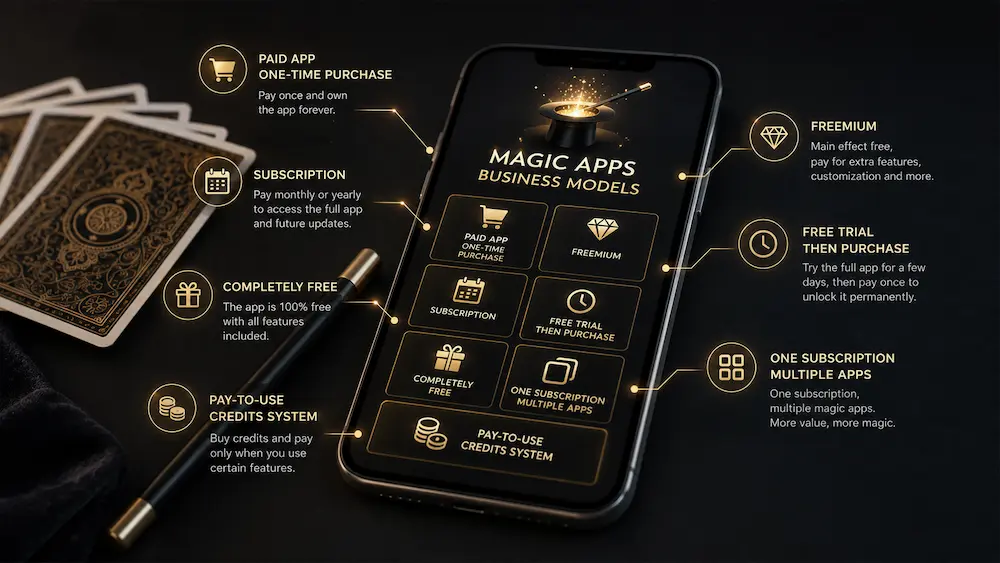
Creating a strong magic app is only one part of building a successful product. Developers must also decide how users will access the app, how they will pay for it, and what they should receive in return.
The right business model can help an application remain profitable, maintained, and compatible with future versions of iOS and Android. The wrong model can frustrate users, reduce downloads, or make the project financially impossible to support over time.
There is no universal solution. A simple, self-contained magic effect may be ideal as a paid app, while a professional tool connected to online services may require a subscription. An application that generates content through artificial intelligence may need a credit system, while another app may work better as a completely free companion to a physical product.
Here are the main business models available to magic app developers, ordered from the most familiar to the most specialized.
1. Paid App — One-Time Purchase
The paid app is the most traditional and straightforward business model.
The user pays before downloading the application and receives permanent access to the complete product. There is no free trial, no subscription, and no additional payment required to unlock the main effect.
The principle is simple:
One app, one price, one purchase.
This model is particularly familiar in the magic industry. Magicians are already accustomed to purchasing individual tricks, gimmicks, books, downloads, and instructional videos. Buying a magic app for a fixed price follows the same logic.
A magician discovers the effect, watches the demonstration, reads the description, purchases the product, and can then use it without worrying about recurring fees.
Advantages
The pricing is clear and easy to understand. The customer knows exactly how much the app costs before downloading it.
There is no need to manage a subscription, monitor remaining credits, or wonder whether access will disappear after a payment is cancelled.
The developer also receives revenue immediately from every customer. This can be especially helpful when launching a new application or funding the development of future products.
A fixed price can also position the app as a premium magic product rather than a general mobile application.
Limitations
The greatest weakness is that users cannot properly test the app before purchasing it.
A demonstration video can show the final effect, but it cannot always prove how reliable, discreet, customizable, or comfortable the app is during a real performance.
This can create a significant barrier, especially when the application is expensive or comes from an unknown developer.
The second challenge is long-term maintenance. The developer receives money once, but customers may expect the application to remain compatible with future devices and operating systems for many years.
If the app requires frequent updates, technical support, servers, or external services, a single payment may not be enough to finance its future.
Best suited for
The paid app model works particularly well for:
- Self-contained magic tricks
- Offline effects
- Simple prediction apps
- Card forces
- Calculator tricks
- Companion apps for specific routines
- Products with limited operating costs
- Effects that do not require constant updates
2. Freemium
With a freemium model, the application is free to download and offers a genuinely usable experience without payment.
The developer then sells additional features, effects, customization options, integrations, or professional tools through in-app purchases.
For a magic application, the main effect could remain free forever, while paid options might include:
- Custom card backs
- Alternative reveals
- Additional routines
- Performer branding
- Haptic feedback
- Apple Watch support
- Remote controls
- Extra themes
- More prediction methods
- Connected-device integrations
- Advanced settings
The most important principle is that the free version must provide real value.
Freemium should not mean that the app is technically free but almost unusable without payment. Users should be able to understand, test, and ideally perform the core effect before deciding whether the premium features are valuable to them.
Advantages
Freemium greatly reduces the barrier to entry. Users can download the app, experiment with it, and understand how it works without taking any financial risk.
This can help the application reach a much larger audience and encourage recommendations within the magic community.
A good free effect may also build trust in the developer. Once users are satisfied with the core experience, they may be more willing to purchase additional options.
Freemium is particularly powerful when personalization is important. Different performers may want different card designs, languages, themes, reveal styles, or external-device support.
Instead of forcing every customer to pay for features they do not need, the app can allow each user to build the version that suits their performance style.
Limitations
Many users may never pay.
If the free version is too complete, customers may have little reason to unlock premium features. If it is too limited, they may feel manipulated and uninstall the app before discovering its value.
Finding the right balance is therefore difficult.
The premium options must feel desirable without making the free experience intentionally frustrating.
Freemium apps can also become more complicated to develop. The application must manage different access levels, purchases, restoration, locked features, and clear explanations of what is free and what requires payment.
Best suited for
Freemium works well for:
- Apps with a simple core effect
- Customizable magic tools
- Prediction systems
- Training and practice apps
- Card utilities
- Creative tools
- Apps with optional connected-device support
- Products with additional routines or expansion packs
3. Monthly or Annual Subscription
With a subscription model, the application is usually free to download, but users must pay regularly to continue accessing the full product.
The payment may be monthly, yearly, or offered through both options.
A subscription is not simply a way of dividing the price into smaller payments. It represents an ongoing relationship between the developer and the customer.
In exchange for recurring payments, users should receive continuing value, such as:
- Regular updates
- New effects
- Additional features
- Compatibility improvements
- Cloud synchronization
- Online services
- Technical support
- New themes or routines
- Security and reliability improvements
A low monthly fee may make an advanced app more accessible because the user does not need to make a large payment immediately.
Advantages
Subscriptions generate recurring revenue.
This gives developers a more predictable income and can help finance long-term development, server costs, customer support, and compatibility updates.
It is especially useful for apps that depend on cloud hosting, databases, artificial intelligence, remote communication, online accounts, or other services that continuously cost money.
The model also gives the developer a financial reason to keep improving the product.
For professional performers who use the app regularly, a subscription may be acceptable if the application provides reliable value during shows.
Limitations
Subscription fatigue is a major concern.
Users already pay monthly for entertainment, software, cloud storage, productivity tools, and many other digital services. Even a relatively small additional fee may be rejected if the magic app is only used occasionally.
A subscription also creates strong expectations.
Customers will expect regular updates, active support, technical reliability, and visible improvements. Charging every month for an app that rarely evolves can quickly damage trust.
The developer must also consider what happens when a subscription ends. If the app becomes completely unusable, users may be reluctant to build important routines around it.
Best suited for
Subscriptions are appropriate for:
- Frequently used professional tools
- Continuously updated applications
- Cloud-connected effects
- AI-powered magic apps
- Remote performance systems
- Apps with recurring server costs
- Platforms offering new content regularly
- Professional utilities requiring long-term support
4. Free Trial Followed by a One-Time Purchase
This model combines the benefits of a free trial with the simplicity of permanent ownership.
The user downloads the application for free and receives temporary access to the full product. After the trial ends, a single payment permanently unlocks the app.
The trial can be limited in several ways:
- A fixed number of days
- A limited number of performances
- A limited number of generated predictions
- Access to selected features
- A demonstration mode
- A restricted setup or customization mode
After testing the application, the user can decide whether it is suitable for real performance.
Advantages
This model reduces uncertainty.
Magic apps can be difficult to evaluate through screenshots and trailers alone. A performer may want to test the setup, timing, interface, reset process, reliability, customization, and spectator management before purchasing.
A free trial allows the magician to experience the real workflow.
At the same time, the final purchase remains simple. Once the app is unlocked, the customer has permanent access without recurring fees.
This can be an excellent compromise between customer confidence and developer revenue.
Limitations
The developer needs a reliable system to manage the trial.
Some users may attempt to extend free access by reinstalling the app, using another account, or changing devices.
The trial must also be long enough to demonstrate the product but short enough to encourage a purchase.
If the application requires many days of preparation or rehearsal, a very short trial may not be useful.
As with a standard one-time purchase, the developer must also consider how future maintenance will be funded after the initial sale.
Best suited for
This model is particularly effective for:
- Premium magic tools
- Expensive applications
- Complex prediction systems
- Remote-control apps
- Professional utilities
- Effects requiring rehearsal
- Apps whose value is difficult to demonstrate in a video
5. Completely Free
A completely free app gives users access to all its features without subscriptions, credits, advertisements, or paid upgrades.
At first, this may not appear to be a true business model because the application does not generate direct revenue. However, a free app can still support a larger commercial strategy.
For example, it may be used to:
- Accompany a physical magic product
- Promote a magician or developer
- Build an audience
- Demonstrate technical skills
- Introduce users to a brand
- Attract customers to other paid products
- Support an educational project
- Contribute to the magic community
A free app can therefore be a promotional, strategic, or community-focused product.
Advantages
Free apps are easy to discover, test, share, and recommend.
They can reach a much larger audience because there is no financial barrier.
A well-designed free application can generate goodwill and help establish a developer’s reputation. It may lead users toward other paid apps, physical products, consulting services, collaborations, or custom development work.
It can also introduce beginners to digital magic and encourage experimentation.
Limitations
Free does not mean cost-free for the developer.
The app still requires design, programming, testing, customer support, store management, and compatibility updates.
Online services, databases, hosting, and third-party technologies may also create continuing expenses.
Without direct revenue or another source of financial support, the developer may eventually lose the resources or motivation needed to maintain the product.
This is one reason some free apps disappear or stop working after operating-system updates.
Best suited for
The completely free model is suitable for:
- Promotional applications
- Companion apps for physical products
- Community projects
- Educational tools
- Experimental effects
- Developer portfolios
- Simple offline utilities
- Apps created to support another business
6. One Subscription for Multiple Magic Apps
Instead of selling each application separately, a developer can offer one subscription that unlocks an entire collection of magic apps.
For example, a performer could pay one monthly or annual fee and receive access to several products, such as:
- A card forcing app
- A drawing duplication system
- A calculator prediction
- A remote-control utility
- A digital peek tool
- A video prediction app
- A mentalism database
- A performance assistant
This approach transforms individual applications into a complete digital magic ecosystem.
Advantages
The user receives access to several tools through a single payment.
This can provide excellent value for performers who regularly use multiple apps.
It also improves discovery. A user may subscribe because of one particular effect and later experiment with other products included in the collection.
For developers with a large catalogue, the model can create more predictable revenue and make it easier to promote new releases.
The apps may also work together by sharing:
- Performer profiles
- Settings
- Remote controls
- Spectator information
- Connected devices
- Cloud synchronization
- Common design systems
A connected ecosystem can become more valuable than a collection of unrelated apps.
Limitations
The collection must contain enough high-quality products to justify the subscription.
A large number of weak, outdated, or repetitive apps will not automatically create value.
Some customers may only want one application and may not accept paying for a complete catalogue.
The developer must also maintain several products at the same time. If some apps stop working or receive no updates, the perceived value of the entire subscription can decline.
Pricing is another challenge. The subscription must be affordable for users who only use a few products while remaining profitable for the developer.
Best suited for
This model is ideal for:
- Developers with several complementary apps
- Digital magic studios
- Professional tool collections
- Connected magic ecosystems
- Platforms releasing new effects regularly
- Companies offering apps across multiple categories
7. Pay-to-Use or Credits System
In a credit-based model, the application is free to download, but users purchase virtual credits that are consumed when they perform certain actions.
Credits may be presented as:
- Coins
- Tokens
- Diamonds
- Performance credits
- Generation credits
- Reveal credits
For example, a user might purchase 100 credits and spend one credit every time the app creates a personalized video, generates an artificial-intelligence image, sends a message, or processes information on a remote server.
Unlike a subscription, the user does not pay according to time. The cost is based on actual usage.
Advantages
Users only pay when they use the service.
This can be attractive for occasional performers who do not want a monthly subscription.
It is also useful when each performance creates a real cost for the developer. Artificial intelligence, video rendering, SMS messages, cloud processing, image generation, and voice synthesis may all require paid external services.
A credit system allows those operating costs to be passed on transparently.
Different credit packs can also suit different users. A hobbyist may buy a small package, while a professional performer may choose a larger and more economical bundle.
Limitations
A pay-to-use system can make performers feel that every rehearsal or performance costs money.
This may discourage experimentation and cause users to avoid practicing the effect.
It can also create stress during a live show. A magician must know that enough credits are available and that the app will not suddenly become unusable.
The rules must therefore be extremely clear. Users should know exactly:
- When credits are consumed
- How many credits an action requires
- Whether failed actions are refunded
- Whether credits expire
- Whether an internet connection is required
A credit system can feel unfair when used for simple offline features that create no real cost for the developer.
Best suited for
Credits are most appropriate for:
- AI image generation
- AI voice generation
- Personalized video creation
- SMS-based effects
- Cloud rendering
- Remote server processing
- Paid third-party integrations
- Services with a measurable cost per use
How Should a Magic App Developer Choose?
The best business model depends on the nature of the application and the way magicians will use it.
A self-contained effect used occasionally may be ideal as a one-time purchase. A professional tool used every week may justify a subscription. An app that creates a real cost during every performance may require credits.
Before choosing a model, the developer should consider several important questions.
How often will users open the app?
An application used during every professional performance may support recurring payments.
An effect performed only a few times per year will be much harder to sell through a monthly subscription.
Does each performance create a cost?
If the app relies on artificial intelligence, messaging services, cloud processing, or online rendering, the developer may need subscriptions or credits.
A completely offline app has more freedom to use a one-time purchase.
Will the product require regular updates?
Some apps are technically simple and may remain functional for a long time.
Others depend on operating-system features, connected devices, online services, or external platforms that change regularly.
The more maintenance the app requires, the more important recurring revenue becomes.
Can users understand the value before purchasing?
A simple effect may be easy to demonstrate in a video.
A complex professional tool may need a free trial because its real value depends on reliability, customization, workflow, and ease of use.
Is the app a complete product or part of an ecosystem?
A single trick may work well as a paid app.
A collection of connected tools may be better suited to a shared subscription.
Do customers expect permanent ownership?
Many magicians prefer to buy a secret or method once and keep it permanently.
If the application uses a subscription, the developer must clearly explain why continued payment is necessary and what ongoing value is provided.
Pricing Is Part of the User Experience
Monetization is not only a financial decision. It directly affects the way users experience and trust the product.
A magician should never discover an unexpected payment requirement shortly before a performance.
The app should clearly explain:
- What is free
- What is paid
- What remains accessible after payment
- Whether a purchase is permanent
- How often a subscription renews
- When credits are consumed
- Whether an internet connection is required
- What happens when access expires
Transparency is especially important in magic because performers depend on their tools in front of real audiences.
Confusing pricing, hidden restrictions, or sudden loss of access can damage confidence in both the application and its developer.
The best monetization system is not necessarily the one that generates the highest immediate revenue. It is the one that creates a fair and sustainable exchange between the developer and the performer.
Conclusion
Each business model represents a different promise.
A paid app promises permanent access after one purchase.
A freemium app promises a useful free experience with optional premium improvements.
A subscription promises ongoing value, updates, and support.
A free trial followed by a one-time purchase promises the opportunity to test the product before owning it permanently.
A completely free app promises accessibility and may support a wider promotional or community strategy.
A multi-app subscription promises access to a complete ecosystem of digital magic tools.
A credit system promises flexible payment based on actual usage.
There is no perfect model for every magic application.
The right choice depends on the type of effect, the frequency of use, the cost of operating the service, the level of maintenance required, and the expectations of the magic community.
A successful business model should do two things at the same time: allow the developer to continue supporting the product and make the magician feel that the price is clear, justified, and fair.