
The Connected Magician
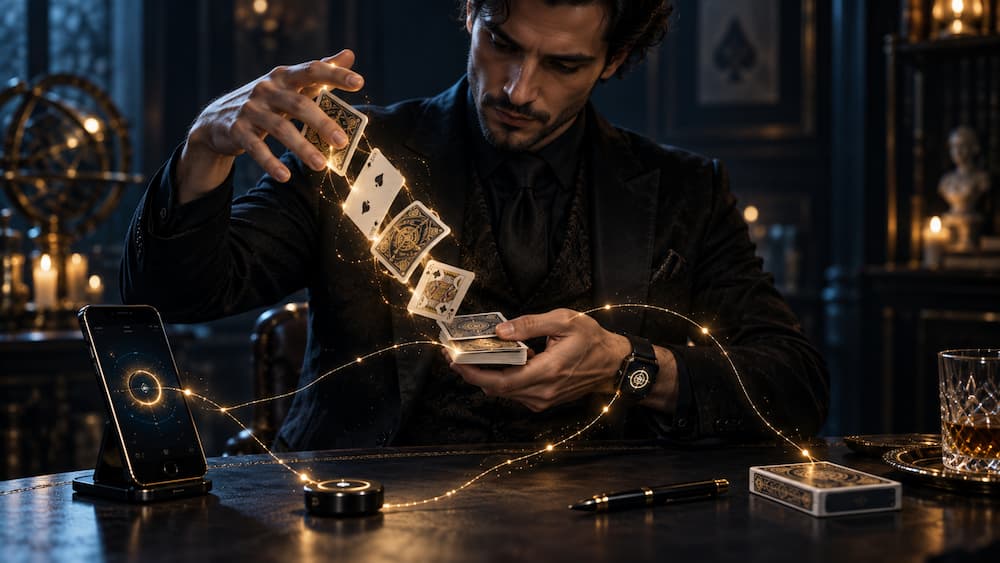
For a long time, digital magic was simple.
A magician opened an app, performed an effect, and put the phone away.
The smartphone was the tool.
Today, that model is beginning to feel almost old-fashioned.
Modern magic apps increasingly communicate with other devices: smartwatches, Bluetooth remotes, electronic props, NFC tags, sensors, headphones, computers, cloud services, and sometimes even other smartphones.
The app is no longer necessarily the trick.
It is becoming the brain of a connected magical ecosystem.
Welcome to the age of the connected magician.
Beyond the Smartphone
The smartphone remains an incredibly powerful tool for magicians. It contains cameras, microphones, accelerometers, gyroscopes, GPS, internet connectivity, Bluetooth, haptics, and enormous computing power.
But perhaps its greatest strength is its ability to communicate with everything around it.
A magic app can receive information from one device, process it invisibly, and transmit the result somewhere else.
The audience may only see a deck of cards, a pen, a watch, or a completely ordinary object.
Behind the scenes, several pieces of technology may be quietly working together.
This changes the role of the phone.
Instead of being the object at the center of the effect, it can become an invisible control system.
And from a magical perspective, that is extremely powerful.
The Smartwatch as a Secret Display
The smartwatch has become one of the most natural companions to magic apps.
It is always accessible, always connected, and already accepted as part of everyday life.
For a magician, it can become a discreet display for secret information.
A word.
A number.
A playing card.
A spectator's choice.
The magician does not necessarily need to remove a phone from a pocket or visibly interact with an application. A quick glance at the wrist may be enough.
And even that glance can sometimes be eliminated.
The watch can communicate through vibration.
Technology has effectively created a new form of silent communication between the software and the performer.
Haptics: Information You Can Feel
This is perhaps one of the most interesting developments in connected magic.
Information no longer has to be seen.
It can be felt.
Different vibration patterns can represent different values, directions, cards, numbers, states, or instructions.
One vibration might mean one thing.
Two vibrations another.
Long and short pulses can create an entire hidden vocabulary.
At that point, the magician is no longer reading information from a screen.
The information is being delivered directly to the body.
This has a major advantage: there may be almost no visible action for the spectator to detect.
The performer can maintain eye contact, continue talking, and receive information at the same time.
When designed well, technology disappears completely from the presentation.
Bluetooth and the Return of the Physical Prop
Interestingly, connected magic is not making physical props obsolete.
It may actually be doing the opposite.
Digital magic originally moved many effects onto screens.
Connected magic allows technology to return inside physical objects.
A button can secretly trigger an action.
A pen can transmit information.
A deck can communicate with a phone.
A sensor can detect movement.
A small remote can control an effect without the magician ever touching the screen.
This creates an interesting reversal.
The technology becomes more sophisticated, while the effect can appear increasingly analog.
From the spectator's perspective, there may be no technology involved at all.
That is an important distinction.
The most technologically advanced magic does not necessarily need to look technological.
One Device Talks to Another
Once devices can communicate, completely new structures become possible.
Imagine a system where one device captures information, another processes it, and a third communicates the result to the magician.
The spectator writes something.
A connected object detects or transmits the information.
The phone receives it.
The software interprets it.
The magician receives the result through a watch or haptic signal.
For the audience, perhaps nothing has happened.
For the magician, an entire digital chain has just operated invisibly.
This is where magic apps begin to evolve beyond traditional applications.
They become systems.
The App as the Brain
In this new model, the app does not always need to be visible.
Its job may simply be to coordinate everything.
It can manage Bluetooth connections.
Interpret sensor data.
Recognize images.
Communicate with web services.
Control timers.
Trigger sounds.
Send information to a watch.
Receive commands from a remote.
Record the state of a performance.
The interface becomes less important than the infrastructure behind it.
This is a fundamental shift.
A traditional app asks:
What can the magician do on this screen?
A connected magic system asks:
What can all these devices do together?
That is a much bigger question.
The Performance Becomes the Interface
There is also another consequence.
When physical actions control the technology, the magician's performance itself can become the interface.
Pressing a hidden button can replace tapping the screen.
Turning the wrist can trigger an action.
Moving an object can change the state of the routine.
A vibration can provide feedback.
The magician is interacting with software without looking like someone interacting with software.
This is particularly important in magic.
Every unnecessary interaction can create suspicion.
Why did the magician touch the phone?
Why did they unlock the screen?
Why did they open that application?
Why did they look at the display?
Connected devices can remove many of these questions.
The technology moves into the background while the performance stays in the foreground.
But Connectivity Creates New Problems
Of course, every connection is also another possible point of failure.
Bluetooth can disconnect.
Batteries can die.
Devices can lose synchronization.
Permissions can change.
Operating system updates can break integrations.
Network-based features can fail when there is no internet connection.
And the more devices involved in a system, the more important reliability becomes.
A trick involving only a deck of cards has very few technical dependencies.
A trick involving a phone, a watch, Bluetooth, a remote device, and an internet service introduces several.
This does not make connected magic bad.
But it means developers have to think differently.
A good magic app cannot simply work perfectly in ideal conditions.
It needs to survive a real performance.
The Importance of Fallbacks
Connected magic systems should ideally be designed around failure.
What happens if the watch disconnects?
What happens if the remote battery dies?
What happens if the internet disappears?
What happens if Bluetooth takes five seconds longer than expected?
What happens if the spectator suddenly wants to hold the phone?
These questions are not only technical.
They are theatrical.
A good connected magic system should provide the magician with ways to recover without destroying the effect.
That might mean reconnecting automatically.
Keeping critical information locally.
Providing more than one method of receiving information.
Allowing manual control when automation fails.
Or simply designing the routine so that the technology is never the only possible path forward.
Reliability is part of the method.
More Technology, Less Visible Technology
There is a strange paradox at the heart of connected magic.
As more technology is added behind the scenes, less technology may be visible to the audience.
A sophisticated system could involve several devices communicating constantly while the spectator sees nothing more than a magician holding a deck of cards.
That may be one of the most important directions in digital magic.
Not bigger screens.
Not more impressive interfaces.
Not more obvious technology.
But better hidden technology.
Technology that supports the magic without becoming the subject of the magic.
A New Kind of Magic Developer
This evolution also changes what it means to build a magic app.
Developers are no longer working only with buttons, screens, and animations.
They may need to understand Bluetooth protocols, wearable devices, sensors, hardware accessories, networking, machine learning, APIs, and real-time communication.
In some cases, building the physical accessory may become just as important as developing the software.
The border between software developer and prop maker is becoming increasingly blurred.
And that could lead to some very interesting creations.
The next important magic application may not simply be something you download.
It may be part of a complete connected object.
The Magician as a Network
Perhaps the most interesting way to think about this evolution is that the magician is becoming a small network.
The phone is the processor.
The watch is the secret display.
The remote is the controller.
The prop is the sensor.
The cloud may provide intelligence.
And the performer connects all of them together.
But the audience should never need to know any of this.
For them, there should only be one thing:
the impossible moment.
The Future Is Connected — and Invisible
Magic has always adopted new technology.
Magnets, electronics, radio systems, hidden cameras, remote controls, smartphones, and now artificial intelligence have all found their way into magical methods.
Connected devices are simply the next step.
But the most exciting part is not the number of devices involved.
It is how invisible those devices can become.
The future of magic apps may not be about creating a better app to look at.
It may be about creating an app you barely need to look at at all.
A silent system connecting the magician, the props, and the digital world.
Always present.
Always communicating.
And, ideally, completely unnoticed.
That is the connected magician.